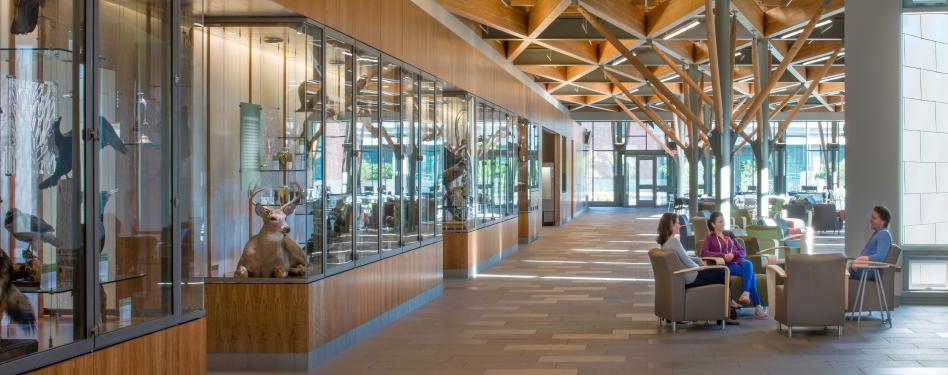
Feature image: The LEED Platinum SUNY-ESF Gateway Center in Syracuse, New York. Photo credit: David Lamb.
The State University of New York College of Environmental Science and Forestry (SUNY ESF), in collaboration with its Center for Sustainable Materials Management (CSMM), has released a new case study detailing the college’s pioneering circular economy solutions and advancement of TRUE certification strategies across campus operations.
Breaking new ground with TRUE precertification
In 2024, SUNY ESF became the first higher-education institution in the United States to achieve campus-wide TRUE precertification for zero waste operations. This milestone recognizes ESF’s dedication to holistic resource management and highlights the college’s alignment with the rigorous performance and transparency standards set by the TRUE rating system.
Recognition for impactful change
ESF’s achievement has received national attention. In October 2024 and again in November 2025, the Post-Landfill Action Network (PLAN) named ESF the #2 Zero Waste Campus in the U.S. In January 2025, Rheaply honored both ESF and CSMM with its Innovator Award, recognizing leadership in circular materials management and campus-wide reuse systems.
Sue Fassler, director of sustainability at SUNY ESF, emphasized the collaborative nature of the progress: “Through collaboration with CSMM and our students, faculty and staff, we are demonstrating that circular economy principles can be applied at every scale of campus operations—from procurement to reuse—and that these systems can inspire real cultural change.”
Measurable results through TRUE
The college’s case study showcases significant data-driven results since beginning its zero waste journey. ESF’s waste diversion rate rose from 29% in 2018 to 56% by the end of 2024, while the total amount of material sent to landfill and incineration decreased by 22% in that time frame.
Key factors in this progress include
- Aggressive expansion of reuse and recycling programs in line with TRUE best practices.
- Enhanced organics recovery and composting efforts.
- Data-driven tracking and transparent environmental reporting.
- Strong cross-departmental coordination and engagement with students and staff.
A road map for the future
SUNY ESF has set its sights on reaching the 90% waste diversion goal required for full TRUE certification at its Syracuse campus and intends to expand these standards to all of its campuses statewide.
SUNY ESF's case study offers actionable insights and detailed strategies for other institutions, businesses and municipalities seeking to implement zero waste practices. The document also narrates ESF’s partnerships with organizations such as GBCI, PLAN, Rheaply and Zabble—highlighting how collaboration can drive systems-level transformation.